V International Scientific Conference on Contemporary Political Processes: Subnational Actors in a Global Polycrisis
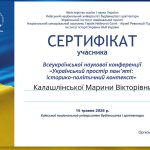
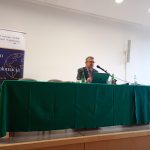
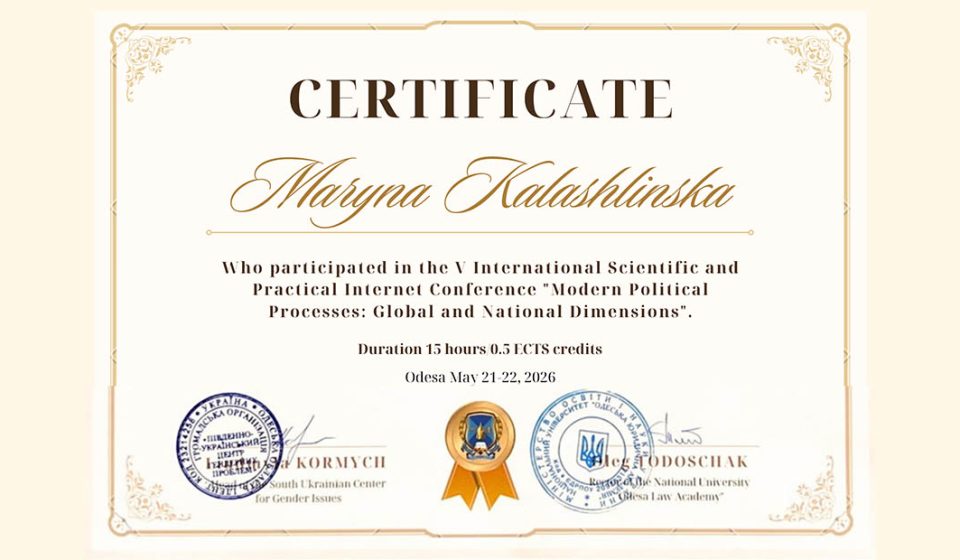
On 21–22 May 2026, the V International Scientific and Practical Internet Conference “Contemporary Political Processes: Global and National Dimensions” was held at the National University “Odesa Law Academy.”
The conference was organised by the university’s Department of Political Theories under the auspices of the Ministry of Education and Science of Ukraine. It brought together researchers, university lecturers, representatives of public authorities and local governments, doctoral candidates and other specialists working on contemporary political transformations.
The conference focused on socio-political stability during wartime and post-war transformations, including national security, multilevel governance, European integration, digital communication, economic and socio-cultural change, and Ukraine’s position in the international system. The event was conducted online, with Ukrainian and English as its working languages.
My contribution to the conference materials was titled:
Transformation of the International Agency of Subnational Actors under Conditions of Global Polycrisis
The paper examines how wars, migration, climate change, humanitarian emergencies and other interconnected crises are transforming the role of cities, regions and local communities in international relations.
Its central argument is that subnational territories can no longer be understood only as administrative units operating within the boundaries of the state. In periods of institutional overload, cities are increasingly required to maintain essential services, protect local communities and develop their own mechanisms of international cooperation.
The analysis connects this transformation with several established theoretical approaches:
- John Agnew’s critique of the territorial trap;
- Ivo Duchacek’s concept of perforated sovereignty;
- Michele Acuto’s research on city diplomacy and transnational city networks;
- the contemporary concept of global polycrisis.
The paper shows that the expansion of city diplomacy is not merely a temporary response to recent emergencies. Transnational municipal alliances are gradually becoming an institutionalised component of multilevel governance.
According to the research discussed in the contribution, the number of international city networks has grown from approximately 60 formalised alliances in 1985 to more than 300 networks identified in recent research. These networks enable cities to exchange knowledge, respond to governance gaps and cooperate across national borders when traditional multilateral institutions are too slow or politically constrained.
The contribution concludes that cities and regions are moving from the position of passive objects of national administration towards a more autonomous and proactive role in international political processes. In the longer term, their resilience, adaptability and capacity for horizontal cooperation may become important elements of an emerging global security architecture.
This topic forms part of my broader research on territoriality, city diplomacy, paradiplomacy and the transformation of political agency under conditions of global instability.