Poland: Diplomacy in the Age of Algorithms with Ambassador Piotr Wilczek
Diplomacy in the Age of Algorithms
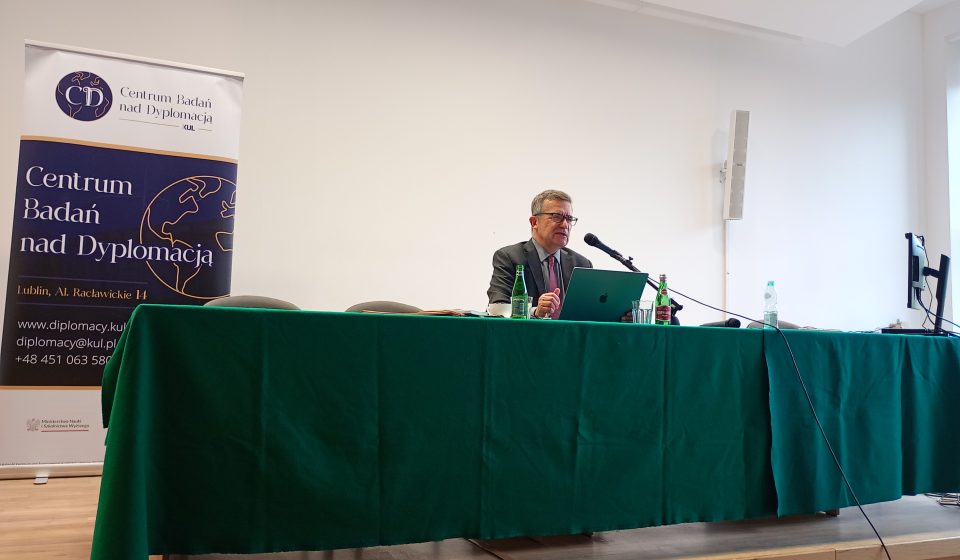
On 29 and 30 May 2026, as part of my postgraduate studies in Diplomacy and Foreign Service at the John Paul II Catholic University of Lublin, I attended a two-day lecture series delivered by Ambassador Piotr Wilczek and organised by the Center for the Study of Diplomacy at KUL.
Ambassador Wilczek, who represented Poland in the United States and the United Kingdom, discussed digital diplomacy, historical diplomacy and cultural diplomacy through examples drawn from diplomatic practice.
The main insight I took from these lectures is that diplomacy has not simply acquired new communication tools. The digital environment has changed its speed, audiences and internal logic. High politics increasingly lives in the smartphone, while attention, visibility and control over interpretation have become important political resources.
High Politics in the Smartphone
Traditional diplomacy developed around discretion, carefully considered language and confidential communication. A diplomatic cable could take hours or days to reach the capital. Today, a single social media post can circulate globally within minutes, influence political debate and provoke an immediate reaction from governments or markets.
This new tempo has also changed the meaning of silence. In classical diplomacy, silence could be deliberate and strategically useful. In digital communication, however, delayed reaction may be interpreted as uncertainty, weakness or an inability to respond. The information vacuum is quickly filled by competing actors and narratives.
Digital diplomacy is therefore more than maintaining an embassy account on social media. It is the strategic use of digital technologies to pursue foreign-policy objectives, communicate with societies, build relationships, monitor public debate and mobilise international support.
The challenge is to communicate quickly but not impulsively, clearly but not simplistically, and visibly without reducing diplomacy to self-promotion.
Artificial Intelligence and Diplomatic Work
Artificial intelligence is already transforming the practical work of diplomats.
An analytical briefing based on open sources, which might previously have required an embassy team to work for an entire day, can now be prepared within minutes using a well-designed prompt. This can significantly accelerate research, monitoring and preparation for meetings.
The advantage comes with an important limitation. Public AI tools cannot safely process classified documents, confidential diplomatic correspondence or sensitive personal information. Diplomacy therefore needs secure and closed AI environments that combine technological efficiency with strict protection of information.
Platforms, Leaders and the Competition for Attention
Social media allows political leaders to bypass traditional media and communicate directly with domestic and international audiences.
Donald Trump demonstrated how platforms can be used to impose an agenda and announce decisions without relying on conventional journalistic channels. At the beginning of Russia’s full-scale invasion, Volodymyr Zelensky’s short videos recorded in Kyiv became a powerful instrument of digital diplomacy and international mobilisation.
The same logic increasingly applies to diplomats. Ambassador Wilczek gave the memorable example of the Japanese Ambassador in London, whose photographs with Paddington Bear received thousands of reactions, while carefully prepared institutional embassy posts often attracted only a fraction of that attention.
The example may appear amusing, but it raises a serious question: how can a state compete for visibility without sacrificing credibility and institutional dignity?
Algorithms reward emotion, personality and recognisable visual formats. Diplomatic communication must take this logic seriously, while remembering that popularity is not the same as influence and that the most important negotiations still require discretion, trust and direct personal contact.
Disinformation as Anti-Diplomacy
Digital technologies can support public diplomacy, cultural exchange and international solidarity. They can also be used for manipulation, polarisation and the destruction of trust.
Ambassador Wilczek described Russian disinformation as a form of anti-diplomacy. Its purpose is not necessarily to create an attractive image of Russia. Rather, it seeks to weaken social cohesion, undermine confidence in democratic institutions and make citizens believe that no source of information can be trusted.
In this environment, the struggle over territory is accompanied by a struggle over narratives. Information is no longer only a means of explaining policy. It has become an instrument of political power and conflict.
Historical Memory and Cultural Diplomacy
The second day of the lecture series broadened the discussion from digital communication to historical and cultural diplomacy.
One of the most valuable observations was that states do not enter international relations without memory. Their decisions are shaped by experiences of war, occupation, lost sovereignty, empire, victory and betrayal.
Historical diplomacy must therefore distinguish among academic history, social memory and the politics of memory. Its purpose should not be to impose one national interpretation of the past, but to explain why particular events, figures and symbols remain politically and emotionally significant.
A diplomat becomes, in this sense, a translator of memory. The same historical event may occupy a central place in one country’s identity and remain almost unknown in another. Effective diplomacy requires not only defending one’s own historical perspective, but also understanding the experiences and sensitivities of the audience.
Cultural diplomacy follows a similar principle. It is most convincing when it grows from authentic cultural influence rather than artificial state promotion. Literature, music, food, education and shared historical figures can strengthen a country’s soft power, but only when the message is adapted to the local context and avoids propaganda.
My Main Reflection
The lectures showed that digital, historical and cultural diplomacy are not separate worlds.
Algorithms influence which historical narratives become visible. Cultural symbols compete for attention on digital platforms. Disinformation exploits unresolved historical grievances. Artificial intelligence accelerates analysis but also creates new security risks.
Modern diplomacy must therefore combine technological competence with historical awareness, cultural sensitivity and professional judgement.
The smartphone may have become one of the principal arenas of international politics, but it has not replaced the foundations of diplomacy: trust, knowledge, responsibility and the ability to understand how others interpret reality.
And, as Ambassador Wilczek observed with some humour, diplomacy is becoming more sober as well. The era in which everything was supposedly settled over a glass is gradually disappearing.
Many thanks to Ambassador Piotr Wilczek for an engaging and thought-provoking lecture series, and to the Center for the Study of Diplomacy at KUL for organising the meetings.