All-Ukrainian Scientific Conference on Memory Politics and Local Territories
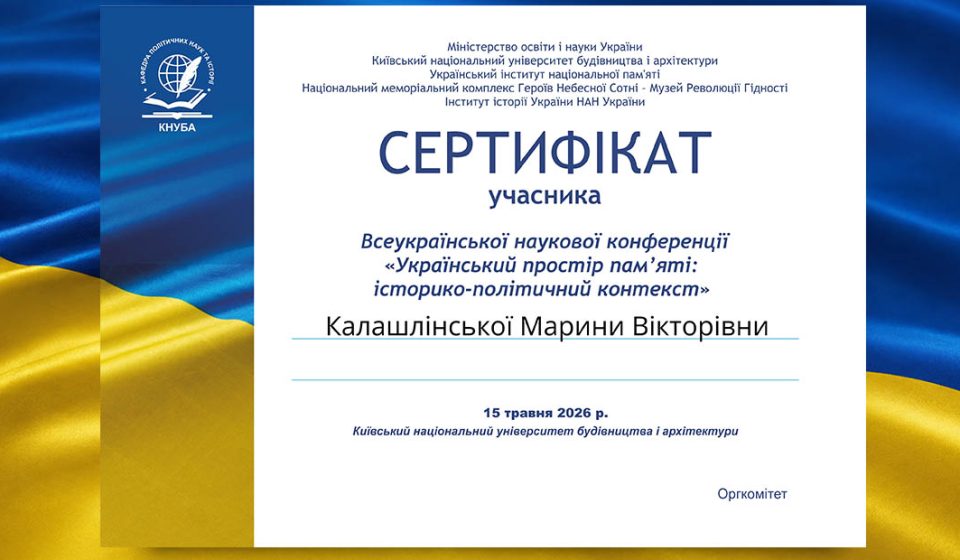
On 15 May 2026, the All-Ukrainian Scientific Conference “Ukrainian Memory Space: Historical and Political Context” was held at the Kyiv National University of Construction and Architecture in Kyiv and online.
The conference was organised with the participation of the Ministry of Education and Science of Ukraine, the Ukrainian Institute of National Memory, the National Memorial Complex of the Heavenly Hundred Heroes – Museum of the Revolution of Dignity, and the Institute of History of Ukraine of the National Academy of Sciences of Ukraine.
Its programme focused on memory politics, national identity, post-imperial and postcolonial legacies, wartime commemorative practices, the role of public institutions, education, culture, media and digital technologies in shaping Ukraine’s memory space.
My contribution to the conference materials was titled:
Local Territories as Spaces of Memory and Ukraine’s Political Subjectivity in Wartime
The paper examines how Ukrainian cities, towns and villages are becoming not only places where wartime experience is preserved, but also spaces in which political agency is formed.
The central argument is that memory politics in wartime is increasingly decentralised. Commemorative practices are created not only by state institutions, but also by local communities that have experienced occupation, resistance, destruction, evacuation, loss or the reception of internally displaced people.
The paper discusses Okhtyrka, Moshchun and Voznesensk as examples of local territories whose wartime experience acquired national significance. Volunteer centres, destroyed bridges, damaged buildings, shelters, sites of civilian and military deaths, oral testimonies and spontaneous memorials become new markers of local and national memory.
The analysis identifies several practical dimensions of this transformation:
- documentation of war crimes and eyewitness testimonies;
- creation of local archives, memorial books and digital memory platforms;
- preservation and museumification of material traces of war;
- decolonisation of place names and removal of imperial symbols;
- commemoration of individual biographies rather than anonymous statistics;
- inclusion of local experiences in the broader Ukrainian historical narrative.
These practices give memory not only symbolic, but also political and legal significance. Documented testimonies can contribute to future legal proceedings, while the decolonisation of public space enables communities to replace imposed imperial codes with names and symbols connected to Ukrainian history and local resistance.
The contribution concludes that local communities are no longer passive recipients of an official national narrative. Through commemoration, documentation and symbolic redefinition of territory, they become active participants in shaping how the war is understood and remembered.
This research forms part of my broader work on territoriality, political agency, memory politics and the transformation of local communities under conditions of war.