The Örebro Conference: Truth Matters – Mis(sing) Information
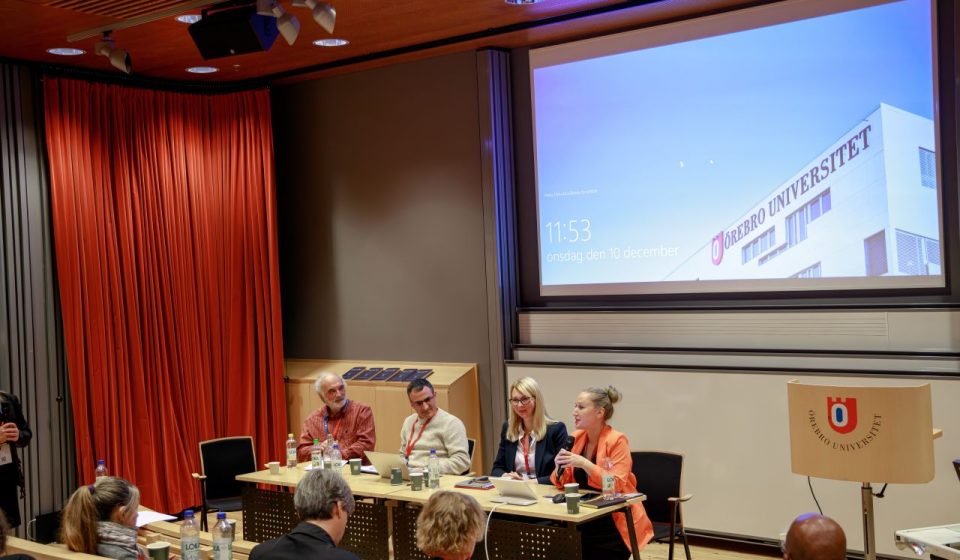
It was a privilege to participate in the Truth Matters – Mis(sing) Information Conference, held at Örebro University on 9-10 December 2025. The conference brought together researchers from different disciplines to reflect on truth, responsibility, academic freedom, and decision-making in an increasingly contested information environment.
My presentation, “Grey Zones and the Information Dimension of Hybrid Conflicts,” examined the role of engineered ambiguity in contemporary hybrid aggression. Such aggression operates by blurring established distinctions: between war and peace, legality and illegality, domestic and external interference, and political subject and object.
The central argument of my presentation was that information should not be understood merely as an additional instrument of conflict. It is itself a central battlefield. Through the manipulation of legitimacy, identity, language, and public perception, political reality can be reshaped before aggression is formally recognised or clearly named.
Grey zones—whether informational, political, legal, or territorial – develop precisely where responsibility is dispersed and hostile actions remain open to competing interpretations. Ambiguity is therefore not simply an accidental feature of hybrid conflict. It can be deliberately produced and maintained in order to delay political responses, complicate legal attribution, and weaken public consensus.
The conference provided a valuable interdisciplinary setting in which these questions could be discussed alongside broader debates on misinformation, truth, institutional responsibility, democratic resilience, and academic freedom. Particularly important was the Truth Matters session marking 25 years of Scholars at Risk, which highlighted the continuing need to defend researchers and academic institutions in environments shaped by political pressure, war, disinformation, and democratic erosion.
I am sincerely grateful to the conference chairs, Magnus Kristoffersson and Eleonor Kristoffersson, for the invitation and for creating such a thoughtful and welcoming academic space. I would also like to thank Yurii Orzikh for his support throughout the preparation process, and Clara Rydén and Noel Afifi for their excellent organisation, communication, and coordination.
My thanks also go to the leadership of Örebro University – Åke Ingerman, Dimitri Beeckman, and Susanne Strand – and to all conference participants for the stimulating presentations, discussions, and conversations that extended beyond formal academic exchange.
Special thanks to Hanna Orzikh for the photographs that documented the atmosphere and intensity of the conference.
The discussions in Örebro reinforced an important conclusion: defending truth in contemporary politics requires more than correcting false statements. It also requires understanding how ambiguity is constructed, how responsibility is obscured, and how the boundaries of political reality are gradually redefined.