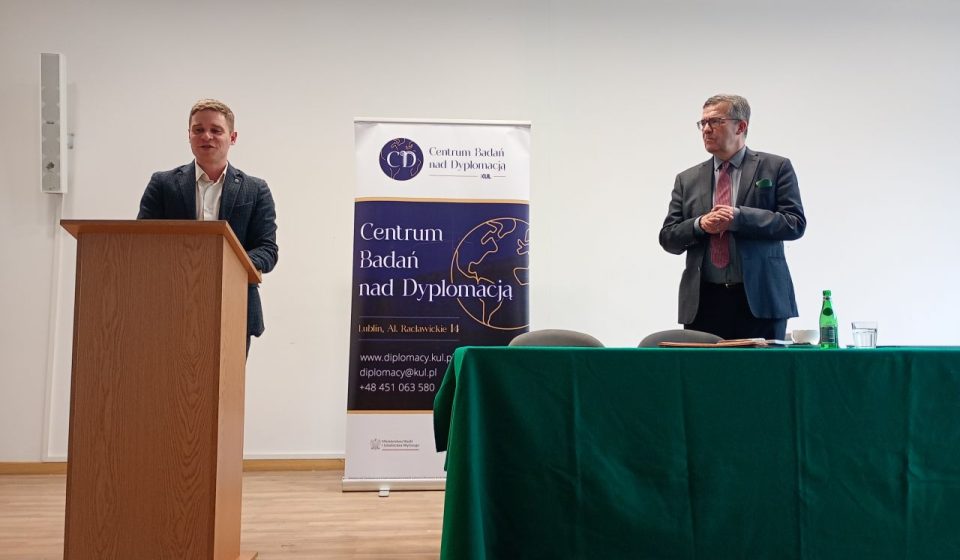
Lecture delivered on 29 May by Ambassador Piotr Wilczek
The main takeaway from the lecture delivered on 29 May by Ambassador Piotr Wilczek on digital diplomacy is that the digital age has profoundly transformed diplomacy.
Today, high politics increasingly “lives in the smartphone”. Politicians and diplomats must take algorithms seriously and compete for attention, visibility and the ability to promote their own interpretation of reality.
A few insights that stayed with me 👇
🤖 AI in diplomacy
Artificial intelligence can significantly speed up routine work. An analytical briefing that once took an embassy team a whole day can now be generated in a few minutes with a good prompt. At the same time, open AI systems create serious risks for confidential data, which is why diplomacy needs closed and secure AI platforms.
🧠 Social media and high politics
Digital platforms are no longer just communication tools. Donald Trump has used posts to bypass traditional media, while Volodymyr Zelensky’s short phone videos from the empty streets of Kyiv became a powerful instrument of digital diplomacy at the beginning of russia’s full-scale invasion.
🤐 Silence has changed its meaning
In classical diplomacy, silence could be a useful instrument. In the digital era, if you do not react quickly, the information vacuum can immediately be filled by opponents and their narratives. Silence may easily be read as weakness.
🧸 The diplomat as an influencer
A carefully drafted embassy statement may receive 30 likes. Meanwhile, a post by the Japanese Ambassador in London with Paddington Bear can attract thousands of reactions and positive media coverage. This is no longer only amusing. It raises a real question about how states compete for attention and influence.
🧨 russian “anti-diplomacy”
Its goal is not to build a positive image of russia, but to destroy trust and cohesion within other societies. In this sense, disinformation is not just a communication tool. It is a political weapon.
🍷 A bonus for those who read until the end
Alcohol diplomacy is also not what it used to be. According to Ambassador Wilczek, the times when “everything was settled over a glass” are gradually disappearing. Modern diplomacy is becoming not only more digital, but also significantly more sober.
Many thanks to Ambassador for an inspiring lecture and to the Center for the Study of Diplomacy KUL for organizing it.