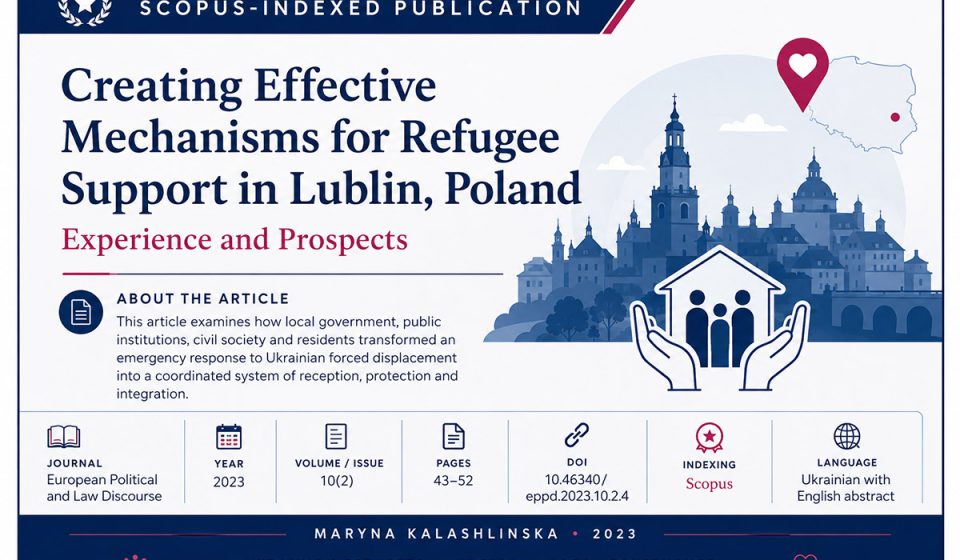
Scopus-Indexed Publication: Creating Effective Mechanisms for Refugee Support in Lublin, Poland
Russia’s full-scale invasion of Ukraine produced the largest forced displacement crisis in post-war Europe. Poland became one of the principal countries of arrival, while Lublin and the surrounding Lublin Voivodeship assumed a particularly important role because of their proximity to the Polish-Ukrainian border.
My article, “Creating Effective Mechanisms for Refugee Support in Lublin (Poland): Experience and Prospects,” examines how public authorities, local governments, civil society organisations, humanitarian actors, educational institutions, businesses, churches, volunteers and local residents responded to the arrival of millions of displaced Ukrainians after 24 February 2022.
The article was published in 2023 in European Political and Law Discourse, a journal covered by Scopus for the publication year concerned. It documents the emergency phase of the Ukrainian refugee response and analyses how spontaneous solidarity was gradually transformed into a more structured system of reception, protection and integration.
The study is especially significant because it combines my academic research with professional experience at the International Cooperation Centre of the Lublin City Administration. It therefore examines refugee support not only as a humanitarian challenge, but also as a problem of local governance, institutional coordination and long-term urban integration.
Lublin as a Gateway City for Ukrainian Refugees
Lublin’s role in the refugee response was shaped by geography, existing Polish-Ukrainian connections and the institutional experience accumulated before 2022.
Lublin Voivodeship directly borders Ukraine and contains several road and railway border crossings. From the first hours of the full-scale invasion, the region became a gateway through which people fleeing shelling and occupation entered Poland.
Many arrivals were women, children and older people. Some intended to remain in Lublin or elsewhere in Poland, while others were travelling onwards to different European countries. This meant that local and regional institutions had to perform several functions simultaneously:
- provide immediate safety and humanitarian assistance;
- organise transportation from the border;
- offer reliable information and temporary accommodation;
- identify medical and psychological needs;
- support onward travel;
- create access to education, employment and public services;
- prepare for the longer-term integration of people who decided to remain.
The article uses Lublin as its central case while drawing extensively on evidence from the wider Lublin Voivodeship. This reflects the functional relationship between the city, border crossings, regional institutions and the municipalities involved in the refugee response.
From Emergency Assistance to a Support System
One of the main conclusions of the article is that effective refugee support cannot be reduced to a single programme or institution.
During the first stage of the crisis, much of the response was spontaneous. Volunteers arrived at railway stations and border crossings, residents offered rooms in their homes, organisations collected food and clothing, and transport was organised for people who had no clear destination.
This mobilisation was essential, but a prolonged displacement crisis could not depend exclusively on emergency volunteering. The initial response therefore had to be converted into a coordinated system with clearer responsibilities, stable financing, legal rules and institutional procedures.
The article identifies ten interconnected areas of refugee support:
- financial assistance;
- organisational coordination;
- transportation from the border;
- reception and information points;
- temporary and longer-term accommodation;
- material and humanitarian assistance;
- access to education;
- employment support;
- healthcare;
- social and integration support.
Together, these areas show that refugee protection is not only a matter of admitting people across a border. It requires a comprehensive public policy that protects rights, meets essential needs and creates conditions for displaced people to rebuild their lives with dignity.
Legal Status and Access to Public Services
An important step in institutionalising Poland’s response was the adoption of the Act of 12 March 2022 on assistance to Ukrainian citizens in connection with the armed conflict on the territory of Ukraine.
The legislation established a framework for legal residence, access to employment, social protection, education and healthcare. It also clarified the ability of national and local authorities to finance and organise assistance.
For many displaced Ukrainians, obtaining PESEL UKR became a gateway to public services and financial support. Eligible families could access child-related benefits, educational support, childcare assistance and other forms of social protection.
The article demonstrates why legal status is central to effective refugee support. Humanitarian aid can respond to immediate needs, but longer-term stability requires legal recognition and access to ordinary public institutions.
At the same time, legislation alone is insufficient. Rights must be supported by understandable information, accessible administrative procedures, language assistance and institutions capable of processing applications rapidly.
Financing the Refugee Response
The scale of the response required major financial mobilisation.
According to the data analysed in the article, by the end of October 2022 the Lublin Voivodeship had allocated more than PLN 446 million to different forms of assistance for Ukraine and Ukrainian refugees. Additional collections organised by local authorities, foundations, associations, non-governmental organisations, churches and businesses generated more than PLN 132.4 million.
These figures do not capture the entire value of assistance. Much of the support took the form of accommodation in private homes, voluntary work, donated goods, informal transportation and services provided without payment. Such contributions were often impossible to quantify.
The article therefore distinguishes between formally recorded expenditure and the wider social value of the response.
This is important for evaluating refugee policy. A system may appear to be funded primarily by government budgets, while in practice it also depends on unpaid labour, private resources, international organisations and local solidarity.
Transportation, Reception and Information
During the initial period, many displaced people crossed the border without a clear plan for onward travel. Some had arrived on foot, while others came by bus, train or private vehicle.
State and local authorities, the fire service, railway operators, military services, humanitarian organisations and volunteers participated in transporting people from border crossings to reception centres, temporary accommodation and destinations elsewhere in Poland.
Special trains and buses were organised, and free transportation was provided from the Polish-Ukrainian border.
Reception and information points became essential coordination hubs. At peak periods, 11 initial reception points operated in Lublin Voivodeship, accompanied by 12 round-the-clock information points, often located at railway stations, bus stations and border crossings.
These centres offered information about accommodation, food, transportation and access to medical or psychological assistance.
Their changing role also demonstrates the transition from emergency response to longer-term integration. As the number of new arrivals decreased, the need shifted from immediate food, transport and temporary shelter towards legalisation, employment, education and social participation.
Housing and Material Assistance
Accommodation was provided through several channels:
- specially adapted collective accommodation centres;
- hotels and other tourist facilities;
- privately offered apartments, houses and rooms.
The article records that 504 collective accommodation facilities, offering almost 10,000 places, were opened in Lublin Voivodeship. By the end of October 2022, almost 90,000 displaced Ukrainians had used collective accommodation in the region at different stages of their journey.
Private households also played a crucial role, particularly during the first months.
Material assistance initially concentrated on food, clothing and hygiene products. Over time, demand expanded to include mattresses, bedding, generators, medicines, medical equipment, household appliances, children’s products and equipment needed in Ukraine.
This changing list of needs illustrates an important characteristic of humanitarian crises: assistance mechanisms must remain flexible. What is essential during the first days of displacement may no longer be sufficient after several months.
Education and Support for Children
Education became a major concern once families had secured initial safety and accommodation.
Ukrainian children could continue attending Ukrainian schools through distance learning or enrol in Polish educational institutions. The article reports that approximately 6,300 Ukrainian children and young people entered the Polish education system in Lublin Voivodeship during the period examined.
Around 35.5% of the Ukrainian refugee children enrolled in regional schools and kindergartens attended institutions in the city of Lublin.
Their inclusion created practical challenges involving language, curriculum differences, psychological well-being and communication with parents. It also demonstrated the importance of intercultural assistants and Ukrainian-speaking educational professionals.
Education is not merely a public service provided to children. It creates routines, social relationships and a sense of safety. Schools also become important points of contact between displaced families and the host society.
Employment and the Cash for Work Programme
Access to employment is one of the principal conditions for moving from humanitarian dependency towards autonomy.
Employment offices established information points and organised campaigns for Ukrainian citizens. Refugees were permitted to register as unemployed and use labour-market services on conditions comparable to Polish citizens.
By the end of October 2022, 2,039 Ukrainian refugees had registered with municipal and district employment offices in the region, while 671 had obtained employment. Employers submitted more than 17,000 notifications concerning the employment of Ukrainian citizens.
A particularly important initiative was the Cash for Work programme, implemented through cooperation between the City of Lublin and the Polish Center for International Aid.
The programme enabled Ukrainian teachers and other professionals to work as teaching assistants, interpreters, intercultural assistants and assistants for students with disabilities. At the time covered by the article, approximately 70 people worked in 39 educational institutions, while two others were employed in the Lublin City Administration.
This programme was significant for several reasons. It provided income, preserved professional skills, supported Polish institutions and improved communication with Ukrainian children and families.
It illustrates how refugee assistance can be designed not only as aid delivered to displaced people, but as a mechanism enabling them to contribute actively to the host community.
Healthcare and Psychological Support
Medical assistance was organised immediately after the beginning of the invasion.
Medical points operated at reception and accommodation centres, while sanitary transport was provided for people requiring further care. More than 2,100 refugees received initial medical assistance at these points, and only around 2% required subsequent hospitalisation.
The article argues that this system helped prevent unnecessary pressure on the wider Polish healthcare system by resolving less serious cases locally and referring patients who genuinely required hospital care.
Ukrainian citizens covered by the special legislation were subsequently granted access to the Polish healthcare system.
Psychological assistance was equally important, although more difficult to organise systematically. Many refugees had experienced shelling, separation from family members, bereavement, uncertainty and sudden loss of home and livelihood.
The work of non-governmental organisations, churches, foundations and community groups was therefore essential in providing psychological support and creating spaces for social contact.
Social Integration and Community-Based Support
The article describes several regional initiatives focused on disability support, Polish-language learning, temporary accommodation and social integration.
Community organisations created integration centres, language and vocational courses, meetings for older people, sports and educational activities for children, cultural events, excursions, workshops and summer camps.
These initiatives reveal that integration is not a single administrative outcome. It is a long-term social process involving language, work, education, relationships, cultural participation and a sense of belonging.
They also demonstrate the value of community-based support. National legislation can establish rights, but local institutions translate those rights into everyday access and practical assistance.
A Whole-of-Society Model
The Lublin experience shows the importance of a whole-of-society approach to forced displacement.
No single actor could have managed the scale of the refugee movement independently. The response depended on cooperation among:
- national authorities;
- regional and municipal governments;
- public services;
- schools and universities;
- humanitarian organisations;
- civil society;
- churches and religious organisations;
- businesses;
- volunteers;
- private residents;
- Ukrainian professionals and community members.
The strength of the model lay in this broad mobilisation. Its vulnerability was that many mechanisms initially depended on extraordinary social solidarity, temporary funding and improvised arrangements.
The long-term challenge is therefore to retain the flexibility and human engagement of the emergency response while building stable institutions, predictable financing and effective coordination.
Research Contribution
The article makes three main contributions.
First, it provides a detailed record of how a Polish border region and city responded during the first phase of mass displacement from Ukraine.
Second, it organises a wide range of measures into a coherent framework of ten support mechanisms, connecting border reception with long-term integration.
Third, it demonstrates the importance of multilevel governance. Refugee support emerged through interaction among national legislation, regional coordination, municipal services, international assistance and community action.
Methodologically, the article is a descriptive institutional case study based on legal acts, official statistics, regional reports, administrative information and documentation from public and humanitarian programmes.
The numerical data should be read as a historical record of the emergency phase covered by the research, rather than as a description of the current situation in Lublin.
Why This Research Matters
The experience of Lublin remains relevant to broader discussions about refugee governance, urban resilience, forced displacement and the role of local authorities during humanitarian crises.
Border cities are often the first institutions required to respond, even though migration and refugee policy are usually designed at national or European level. Municipal authorities must translate general legal frameworks into accommodation, transport, education, employment, healthcare and social support.
The article also highlights the difference between temporary protection and meaningful integration. Legal admission provides safety, but displaced people also require opportunities to regain autonomy, maintain professional identities and participate in the communities where they live.
Lublin’s experience shows that effective refugee support depends on coordination across institutions and on recognising refugees not only as recipients of assistance, but also as professionals, parents, students, employees and members of the local community.
Publication Details
Author: Maryna Kalashlinska
English title: Creating Effective Mechanisms for Refugee Support in Lublin (Poland): Experience and Prospects
Ukrainian title: Створення ефективних механізмів підтримки біженців в Любліні (Польща): досвід та перспективи
Journal: European Political and Law Discourse
Year: 2023
Volume: 10
Issue: 2
Pages: 43–52
Language: Ukrainian, with an English title, abstract and keywords
Indexing: Scopus-covered publication
ISSN: 2336-5439
eISSN: 2336-5447
DOI: 10.46340/eppd.2023.10.2.4
Access: Open Access
Licence: Creative Commons Attribution-NonCommercial-ShareAlike 4.0 International
Read the Article
Read the full article on the journal website
How to Cite This Article
Kalashlinska, M. (2023). Creating effective mechanisms for refugee support in Lublin (Poland): Experience and prospects. European Political and Law Discourse, 10(2), 43–52. https://doi.org/10.46340/eppd.2023.10.2.4