
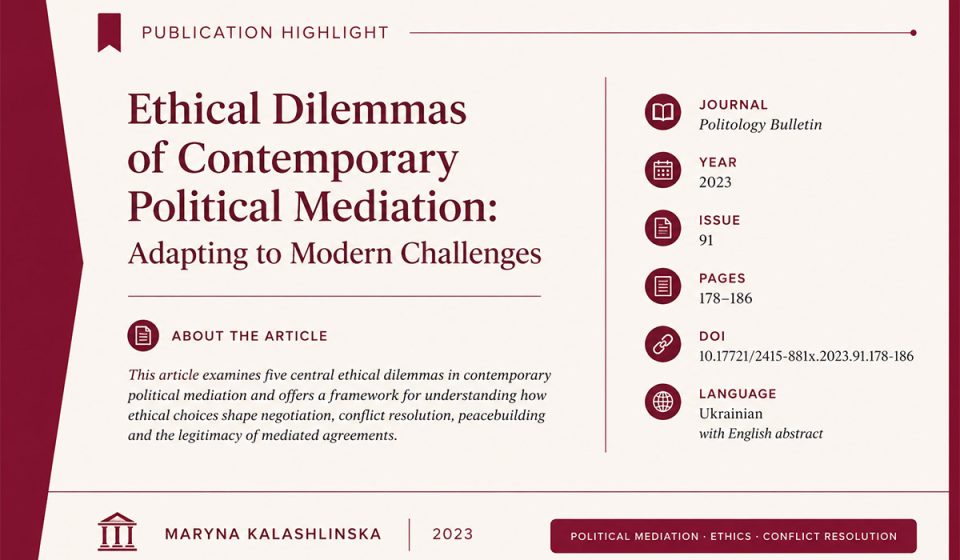
Ethical Dilemmas of Contemporary Political Mediation: Adapting to Modern Challenges
Political mediation is often presented as a practical instrument for de-escalation, negotiation and conflict resolution. Yet every attempt to facilitate an agreement also involves difficult choices concerning legitimacy, responsibility, neutrality and the acceptable limits of compromise.
My article, “Ethical Dilemmas of Contemporary Political Mediation: Adapting to Modern Challenges,” examines how these ethical tensions affect political mediation in a global environment shaped by armed conflicts, geopolitical rivalry, economic interdependence, technological transformation and the growing number of actors involved in international negotiations.
The article was originally published in Ukrainian in Politology Bulletin in 2023. This English-language research note presents its central argument, analytical framework and main findings for an international academic and professional audience.
Ethics as a Central Element of Political Mediation
Political mediation cannot be evaluated only by whether it produces an agreement. The process through which an agreement is reached, the principles compromised during negotiations and the long-term consequences of the settlement are equally important.
The article therefore places ethics at the centre of the analysis of political mediation. It considers the responsibility of mediators, the selection of negotiation strategies and the methods used to restore communication and trust between conflicting parties.
An ethical dilemma arises when a mediator or another participant in a negotiation must choose between competing moral principles or values. In such circumstances, every available decision may produce negative consequences or require the sacrifice of another important principle. Political mediators therefore frequently operate in situations in which there is no entirely neutral, universally acceptable or morally unproblematic solution.
The study combines historical, descriptive and comparative analysis with an interdisciplinary approach drawing on political science, ethics and international relations. Selected cases of international mediation and political negotiation are used to illustrate how ethical dilemmas emerge in practice.
Short-Term Peace versus Long-Term Stability
The first dilemma concerns the tension between achieving an immediate cessation of violence and addressing the deeper causes of a conflict.
A rapid agreement or ceasefire can save lives, reduce suffering and restore communication. At the same time, a settlement that does not address the structural causes of violence may only postpone the conflict. A temporary political compromise can consequently transfer unresolved problems to future generations.
The article discusses the Israeli–Palestinian conflict as an illustration of the difficulty of balancing immediate conflict de-escalation with the need to establish the foundations of sustainable peace.
For mediators, the ethical problem is particularly acute: insisting on a longer and more comprehensive process may prolong current suffering, while supporting a rapid but superficial settlement may contribute to future instability.
Party Autonomy versus Pressure to Reach an Agreement
Respect for party autonomy is one of the fundamental principles of mediation. The parties should be able to define their interests, formulate their positions and decide whether to accept a proposed settlement.
Political negotiations, however, frequently take place under severe time pressure and in situations involving continuing violence or humanitarian costs. A prolonged negotiation process can allow a conflict to escalate and increase the number of victims.
A mediator may therefore be tempted to accelerate the process, advocate a particular solution or use political influence to encourage the parties to accept an agreement. Such intervention may improve the chances of reaching a settlement, but it can also undermine party autonomy, weaken trust and create doubts about the legitimacy of the outcome.
Using the Kosovo conflict as an example, the article demonstrates why political mediators must find a careful balance between respecting the independence of the parties and actively promoting a resolution that serves the broader interests of peace and stability.
Economic Benefits versus Human Rights
Political mediation may also produce agreements that offer substantial economic or humanitarian benefits while requiring compromises concerning human rights, democratic standards or international accountability.
The article examines this tension through the Black Sea Grain Initiative, which facilitated the export of Ukrainian agricultural products during Russia’s full-scale war against Ukraine. The agreement addressed urgent food-security and economic concerns, but it also raised questions about the political and ethical compromises required to secure and maintain the arrangement.
This example shows that political mediation does not occur in isolation from the domestic conduct of the states and institutions involved. The legitimacy of a mediator may also be affected by its own record concerning democratic standards, political opposition and human rights.
The ethical responsibility of a mediator therefore extends beyond securing consensus. It also requires consideration of the wider political context and of the values that may be weakened or marginalised in pursuit of an economically beneficial agreement.
Effectiveness versus Mediator Neutrality
Neutrality is normally regarded as a central condition of legitimate mediation. Nevertheless, the actors best able to influence the parties or provide the necessary political resources are not always entirely neutral.
An influential state or organisation may possess experience, regional knowledge, diplomatic leverage or established relationships that make effective mediation possible. The same connections, however, may create real or perceived conflicts of interest.
The article uses the example of Sri Lanka’s involvement in efforts to facilitate peace during the conflict in Nepal. Sri Lanka’s own experience could be viewed as a source of practical knowledge, but its domestic struggle against armed Maoist movements also raised questions about its impartiality.
The resulting ethical dilemma is not simply a choice between a neutral and a non-neutral mediator. It requires an assessment of whether the practical advantages of involving an influential actor outweigh the risks that perceived bias will damage trust in the negotiation process and the final settlement.
Democratic Values versus International Commitments
The fifth dilemma concerns the conflict between supporting democracy and human rights and respecting existing international agreements, strategic obligations and national interests.
The article considers relations between the United States, China and Taiwan as an example of this tension. Support for democratic institutions and political freedoms may conflict with diplomatic commitments, security considerations and the need to maintain stability between major international actors.
This dilemma reflects a broader problem in international relations: states and mediators may support universal democratic values while simultaneously being required to operate within political and legal arrangements that limit how those values can be defended.
Political mediation therefore involves not only relations between conflicting parties but also the wider structure of international obligations, geopolitical interests and competing conceptions of legitimacy.
Key Argument and Research Contribution
The five dilemmas developed in the article provide an analytical framework for examining the ethical dimensions of political mediation:
- short-term peace versus long-term stability;
- party autonomy versus pressure to reach an agreement;
- economic benefits versus human rights;
- effectiveness versus mediator neutrality;
- democratic values versus international commitments.
This framework shifts attention from the simple question of whether mediation produces an agreement to a more complex set of questions: how was the agreement produced, which principles were protected, which values were compromised, and whether the outcome can contribute to sustainable conflict resolution.
The article does not propose a single universal formula for resolving these dilemmas. Instead, it argues for a context-sensitive and interdisciplinary approach based on continuous ethical reflection, careful analysis of both short-term and long-term consequences, and recognition of the mediator’s responsibility for the legitimacy of the process.
Successful political mediation requires more than negotiation skills or political influence. It also requires an ability to recognise competing values, evaluate difficult compromises and adapt mediation practices to a rapidly changing international environment.
Why This Research Matters
The ethical dimensions of political mediation remain relevant to research on conflict resolution, peacebuilding, international negotiations, diplomacy and global governance.
For scholars, the proposed framework can support comparative analysis of mediation processes and negotiated settlements. For practitioners, it highlights the need to evaluate not only the immediate effectiveness of mediation but also its legitimacy, sustainability and impact on human rights and democratic principles.
As armed conflicts become increasingly internationalised and negotiations involve states, international organisations, private actors and informal intermediaries, ethical responsibility becomes an essential component of effective political mediation.
The article therefore calls for further research into how globalisation, technological innovation, geopolitical transformation and the increasing diversity of mediation actors are changing the ethical foundations of political negotiation and conflict resolution.
Publication Details
Author: Maryna Kalashlinska
Original title: Етичні дилеми сучасного політичного посередництва: адаптація до сучасних викликів
English title: Ethical Dilemmas of Contemporary Political Mediation: Adapting to Modern Challenges
Journal: Politology Bulletin
Year: 2023
Issue: 91
Pages: 178–186
Language: Ukrainian, with an English abstract
DOI: 10.17721/2415-881x.2023.91.178-186
Read the Article
Read the full article in the official journal PDF
View the article on the journal website
Recommended citation:
Kalashlinska, M. (2023). Ethical Dilemmas of Contemporary Political Mediation: Adapting to Modern Challenges. Politology Bulletin, 91, 178-186. https://doi.org/10.17721/2415-881x.2023.91.178-186