The Role of Mediation in Political Negotiations: Rethinking Traditional Approaches
Political negotiations are traditionally understood as direct interactions between conflicting parties seeking to defend their interests, reduce disagreements and reach an acceptable settlement. Yet direct negotiations do not always create the conditions necessary for constructive dialogue. When political positions are deeply entrenched, emotionally charged or strategically incompatible, the absence of a neutral third party may lead not to conflict resolution but to escalation, temporary freezing or the continuation of a prolonged and unresolved conflict.
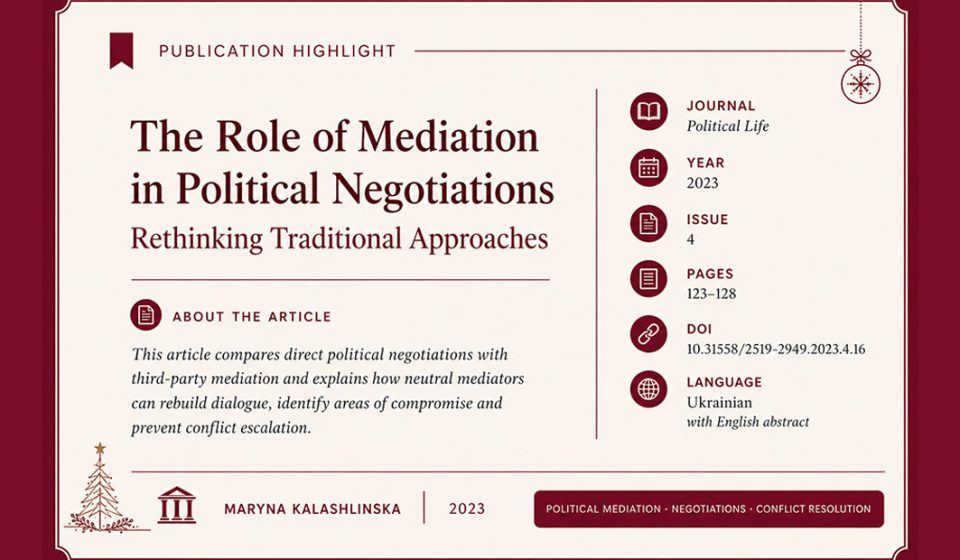
My article, “The Role of Mediation in Political Negotiations: Rethinking Traditional Approaches,” examines political mediation and third-party involvement as an important complement to direct political negotiations. It considers how a mediator can restructure communication, separate declared positions from underlying interests and help conflicting parties identify possible areas of compromise.
The article was published in Ukrainian in Political Life in 2023. This English-language research note presents its central argument, methodology and key findings for an international audience interested in political mediation, diplomatic negotiations, international conflict resolution and peacebuilding.
Why Direct Political Negotiations May Fail
Direct negotiations offer several important advantages. They allow the parties to communicate without intermediaries, discuss disputed issues openly, make decisions relatively quickly and gain a better understanding of one another’s motivations and interests.
These advantages, however, depend on the parties’ willingness and ability to engage in meaningful dialogue. In political conflicts, each side usually approaches the negotiation process through its own interpretation of events, strategic objectives and preferred outcomes. When these elements become inseparable from the parties’ political identities and emotional perceptions of the conflict, direct communication may reinforce disagreement instead of reducing it.
The article uses an analytical model to identify several possible trajectories of a conflict addressed exclusively through direct negotiations:
- successful conflict resolution;
- conflict escalation;
- temporary freezing or postponement;
- transformation into a prolonged or “chronic” conflict.
A temporary ceasefire or frozen conflict should therefore not automatically be treated as a successful settlement. It may simply transfer unresolved tensions into the future while increasing political costs, reducing trust and leaving the parties vulnerable to external interference.
Mediation as a Structured Third-Party Process
Political mediation introduces a third party whose role differs fundamentally from that of a judge or arbitrator. The mediator does not impose a binding decision and does not formally replace the parties in the negotiation process. Instead, the mediator creates and manages the conditions in which the parties can develop their own mutually acceptable solution.
The central advantage of mediation is the mediator’s ability to distinguish among several elements that are often closely intertwined in direct negotiations:
- each party’s perception of the conflict;
- declared political positions;
- underlying interests and needs;
- strategic objectives;
- areas in which compromise may still be possible.
By separating these elements analytically, a mediator can help the parties move beyond an adversarial exchange of fixed positions. The negotiation process can then focus on interests, possible future scenarios and areas of potential cooperation.
The article’s second analytical model places the mediator at the centre of a network connecting the two sides, their interpretations of the conflict, their objectives and their potential points of compromise. This model demonstrates that mediation is not merely the physical presence of an additional participant. It changes the structure of communication and creates alternative pathways through which information, proposals and concessions can move.
Voluntary Participation, Trust and Confidentiality
Political mediation should remain a voluntary process conducted with the consent of the parties. Respect for their sovereignty and decision-making autonomy is one of its essential conditions.
Because the mediator cannot rely on judicial authority, the effectiveness of the process depends heavily on trust. The parties must believe that the mediator understands their perspectives, will maintain communication with both sides and will not use confidential information to benefit one participant at the expense of the other.
Confidentiality is therefore not simply a procedural formality. It allows participants to discuss possible concessions, test proposals and reconsider their positions without immediately exposing every step of the negotiation to political opponents, the media or the wider public.
At the same time, mediator neutrality should not be understood as passivity. A mediator may actively organise the process, formulate procedural rules, evaluate progress, challenge unproductive behaviour and help the parties consider the consequences of failing to reach an agreement.
What a Political Mediator Actually Does
The article identifies several practical functions that a mediator can perform during political negotiations.
A mediator may propose an interim arrangement as the first step towards a broader settlement, demonstrate that alternatives remain available even when the parties perceive the situation as a deadlock, and encourage participants to work within a defined timeframe.
The mediator may also:
- structure the agenda and negotiation procedure;
- maintain the focus of the discussion;
- prevent the agenda from expanding indefinitely;
- distinguish substantive disagreements from rhetorical confrontation;
- support openness and readiness for compromise;
- discourage insincerity or purely competitive behaviour;
- communicate separately with the parties when direct interaction has become unproductive;
- help each side understand the practical benefits and costs of different decisions.
Third-party involvement also produces an important psychological effect. Political actors may find it easier to make a concession in response to a mediator’s proposal than to appear to surrender directly to an opponent. Mediation can therefore create political space for compromise without requiring either party to publicly admit complete defeat.
Who Can Act as a Political Mediator?
Unlike mediation in some judicial or administrative settings, international political mediation is not always conducted by professionally certified mediators. Political authority, practical experience, international reputation and access to the parties may be more important than formal mediation qualifications.
Potential mediators may include:
- respected former political leaders;
- experienced diplomats;
- representatives of international organisations;
- non-governmental conflict-resolution organisations;
- states maintaining constructive relations with both parties;
- special envoys conducting broker or shuttle diplomacy.
The article refers to Theodore Roosevelt’s role in the negotiations that resulted in the Portsmouth Peace Treaty as a historical illustration of mediation by a politically influential individual. It also discusses the involvement of prominent international figures, non-governmental organisations and states capable of using diplomatic credibility or political influence to facilitate negotiations.
The analysis further highlights an important distinction between mediators connected to major powers and representatives of smaller states. Major powers may possess substantial leverage and resources, but their involvement may be interpreted through the lens of strategic rivalry or hegemonic ambition. Diplomats from smaller or formerly peripheral states may sometimes be perceived as less threatening and consequently better positioned to develop trust between the parties.
Mediation Does Not Replace Direct Negotiations
The central argument of the article is not that mediation should replace all direct political negotiations. Direct dialogue remains a fundamental diplomatic instrument and may be the fastest and most appropriate method when the parties are capable of productive communication.
Mediation becomes particularly valuable when direct negotiations have reached a deadlock, when the parties interpret the conflict through incompatible frameworks or when political and emotional pressures prevent them from identifying common interests.
The two methods should therefore be understood as complementary rather than mutually exclusive. Direct negotiations preserve immediate communication and party control, while mediation introduces additional mechanisms for balancing interests, restoring trust and developing solutions that the parties may be unable to formulate independently.
Research Methodology and Contribution
The study combines analytical modelling and comparative analysis. The models illustrate the structural differences between direct bilateral negotiations and mediated political dialogue. Comparative analysis is used to identify the strengths, limitations and possible outcomes of each approach.
The article also draws on illustrative cases, analysis and synthesis, as well as inductive and deductive reasoning. This interdisciplinary combination reflects the complex nature of political mediation, which intersects with political science, international relations, diplomacy, conflict studies, communication, psychology and law.
A particularly important contribution of the article is its emphasis on mediation as a distinct subject of political-science research. Studies of third-party negotiation are often divided among different disciplines or reduced to descriptions of individual historical cases. A political-science perspective makes it possible to examine how power, sovereignty, legitimacy, strategic interests and international status influence both the selection of a mediator and the outcome of the negotiation process.
Why This Research Matters
Contemporary political conflicts increasingly involve not only states but also international organisations, non-governmental actors, informal diplomatic networks and influential individuals. As the number of participants in international politics expands, mediated dialogue becomes an increasingly important alternative to military escalation and prolonged political confrontation.
Understanding political mediation is therefore essential for research on diplomacy, international negotiations, conflict resolution, peacebuilding and global governance. It also has direct practical relevance for governments and international organisations seeking to establish dialogue where direct negotiations have failed.
The article concludes that mediation can promote more balanced communication, reduce misunderstanding and help prevent destructive conflict dynamics. Its effectiveness, however, depends on the mediator’s credibility, impartiality, knowledge of the conflict, ability to maintain relations with both sides and capacity to transform apparently incompatible positions into a structured search for common ground.
This study forms part of my broader research on political mediation and conflict resolution. A related article, “Ethical Dilemmas of Contemporary Political Mediation: Adapting to Modern Challenges,” examines how neutrality, human rights, party autonomy and long-term stability shape the legitimacy of mediation processes.
Publication Details
Author: Maryna Kalashlinska
Original title: Роль медіації у політичних переговорах: переосмислення традиційних підходів
English title: The Role of Mediation in Political Negotiations: Rethinking Traditional Approaches
Journal: Political Life (Політичне життя)
Issue: 4 (2023)
Pages: 123–128
Online publication date: 7 February 2024
Language: Ukrainian, with an English abstract
DOI: 10.31558/2519-2949.2023.4.16
Read the Article
Read the full article in the official journal PDF
View the article on the journal website
Recommended citation:
Kalashlinska, M. V. (2023). The Role of Mediation in Political Negotiations: Rethinking Traditional Approaches. Political Life, 4, 123–128. DOI: 10.31558/2519-2949.2023.4.16