
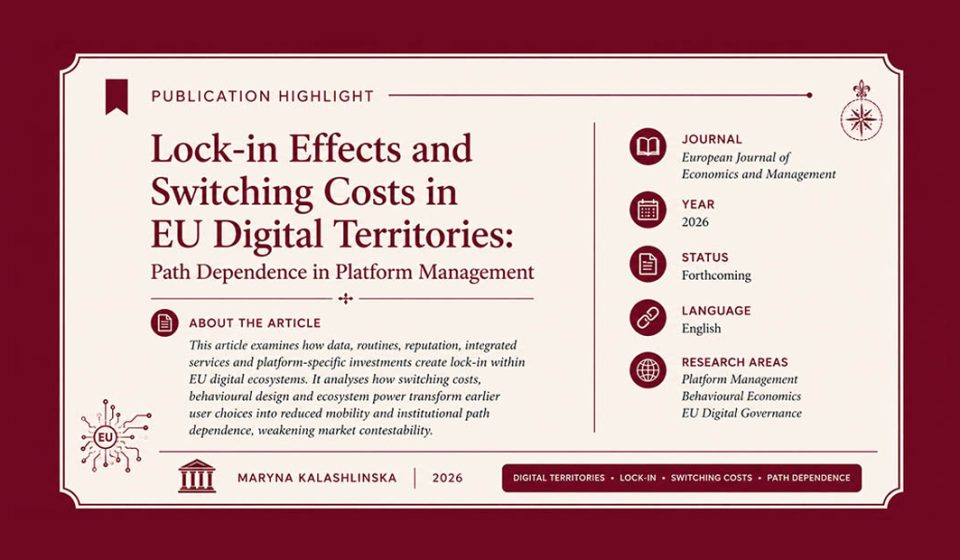
Lock-in Effects and Switching Costs in EU Digital Territories: Path Dependence in Platform Management
Digital platforms are designed to make participation easy. Registration may take seconds, accounts connect automatically, services are integrated, and subscriptions renew without additional action.
Leaving the same ecosystem is often a very different experience.
Users may discover that they cannot easily transfer their data, professional reputation, social connections, reviews, purchased content or established routines. A competing service may formally be available, but moving to it can require considerable time, coordination and acceptance of loss.
My forthcoming article, “Lock-in Effects and Switching Costs in EU Digital Territories: Path Dependence in Platform Management,” examines how this imbalance between easy entry and costly exit develops within consumer-oriented digital platform ecosystems operating in the European Union.
The study treats platform dependency not as the result of a single contractual restriction or deceptive interface. Instead, lock-in is understood as a cumulative process through which data, habits, relationships, reputational assets, complementary services and platform-specific investments gradually reduce the user’s practical ability to leave.
From Platform Use to Institutional Dependence
The article draws on the theory of path dependence, according to which earlier decisions influence and constrain later options.
A user’s initial choice of a platform may appear temporary and easily reversible. However, repeated participation produces learning effects and ecosystem-specific investments. The user becomes familiar with the interface, stores more data, builds professional or social connections and begins to rely on complementary services.
Each individual investment may appear minor. Together, they create a growing cost of exit.
The platform does not need to formally prohibit departure. It may be sufficient to organise the ecosystem so that continued participation remains easier and less disruptive than withdrawal.
This produces a sequence in which:
platform use leads to accumulated assets and routines;
accumulation increases switching costs;
higher switching costs reduce mobility;
reduced mobility reinforces network effects;
network effects strengthen the dominant ecosystem;
and the result is institutional path dependence.
The article’s conceptual model shows that user dependence can therefore move from the level of individual inconvenience to the level of market structure.
The Strategic Design of Lock-in
One of the article’s main contributions is a structured comparison between the mechanisms facilitating entry and those complicating exit.
Behavioural and cognitive mechanisms
Entry is often encouraged through pre-selected options, prominent acceptance buttons, one-click registration and simplified onboarding.
Exit may involve confusing menus, repeated confirmations, warnings about lost benefits or delays before account deletion becomes effective.
These practices interact with well-established behavioural tendencies such as:
- inertia;
- status quo bias;
- loss aversion;
- limited attention;
- reluctance to abandon familiar routines.
A user may therefore remain within an ecosystem even when another service is objectively available or potentially superior.
The relevant issue is not merely the presence of friction. It is the asymmetrical distribution of friction: platforms minimise the effort required to join while allowing the effort required to leave to remain significantly higher.
Contractual and Legal Mechanisms
Platform dependency may also be strengthened through contractual arrangements.
Zero-price access, free trials and subsidised services can attract large numbers of users and accelerate network effects. Participation is frequently conditioned on broad, standardised terms accepted through bundled consent.
Withdrawal can later be complicated by automatic renewal, unclear termination rules, procedurally difficult cancellation or contractual provisions that restrict the practical ability of users to challenge platform decisions.
Formal consent does not necessarily mean that users possess meaningful contractual mobility. A person may have legally accepted the terms and still be unable to leave without sacrificing substantial economic or social value.
Technical and Economic Mechanisms
The most durable forms of lock-in often arise from the technical and economic organisation of the ecosystem.
A platform may integrate accounts, payments, storage, communication tools, marketplaces and professional services. The value of each element increases because it is connected to the others.
Over time, users and businesses may accumulate:
- data and digital content;
- customer and professional contacts;
- ratings and reviews;
- reputational capital;
- technical integrations;
- platform-specific business processes;
- access to developers, sellers and complementary services.
Limited interoperability and weak data portability make these resources difficult to move. A person may technically be free to open an account elsewhere, but unable to transfer what has already been built.
For businesses, the consequences can be even more serious. Leaving a dominant marketplace or platform may mean losing customers, reviews, sales history, technical compatibility or access to essential commercial infrastructure.
Ecosystem Power
The article distinguishes traditional market power from ecosystem power.
Market power is usually discussed through prices, competitors and the external position of a firm. Ecosystem power operates through the internal organisation of relationships among consumers, sellers, advertisers, developers and other participants.
A platform operator can determine access conditions, organise visibility, distribute costs among different groups and connect services across several markets.
For example, control over an operating system, search engine, app store or major marketplace may allow a company to direct users towards its own adjacent services. This produces cross-market leverage and makes the ecosystem more difficult to challenge as a whole.
Competitors must then offer more than a better product. They must persuade users to abandon data, relationships, routines and resources accumulated inside the dominant environment.
This is why switching costs can weaken market contestability even when formal competition continues to exist.
Digital Territories
The article uses digital territories as a supplementary analytical framework.
A platform ecosystem resembles a non-physical territory because participation takes place inside an organised environment with controlled access, internal rules, infrastructure and conditions of inclusion and exclusion.
The analogy does not suggest that platforms and sovereign territories are institutionally identical. Its purpose is to draw attention to the practical meaning of boundaries.
The functional boundary of a digital territory is not necessarily created by a formal prohibition on exit. It may be created by the resources a user would lose by crossing that boundary.
In this perspective, the most important question is not whether departure is legally permitted, but whether it is economically and behaviourally realistic.
A person may possess a formal right to choose another platform while lacking the practical capacity to transfer activities, relationships and accumulated value.
Why Formal Consumer Choice Is Insufficient
Traditional consumer protection is essential, but it frequently focuses on individual transactions: whether information was disclosed, consent was obtained, cancellation is legally possible or a contractual term is unfair.
Platform lock-in is broader.
A user may receive all required information and still remain dependent because the costs of switching are structural rather than merely contractual.
The article therefore argues that real consumer autonomy should be evaluated through the practical conditions of mobility. Relevant questions include:
- Can data be transferred in a usable format?
- Can reputation and reviews follow the user?
- Are competing services interoperable?
- Can subscriptions be cancelled as easily as they are started?
- Can professional activity move without disproportionate disruption?
- Does departure require the loss of accumulated social or economic capital?
The difference between formal choice and effective mobility is central to understanding digital platform power.
Implications for EU Platform Governance
The European Union’s increasing attention to interoperability, portability, market contestability and systemic platform obligations reflects the growing recognition that transparency alone cannot resolve structural dependency.
The article argues that effective governance should evaluate both entry and exit.
Platforms naturally seek user retention, and not every switching cost is intentionally manufactured. Some dependence develops because integrated services genuinely create value.
However, managerial decisions can reinforce these natural dependencies. Defaults, subscriptions, technical compatibility, interface design and restrictions on portability may transform ordinary user participation into a durable competitive advantage.
The regulatory question is therefore not whether platforms are allowed to create attractive ecosystems. It is whether those ecosystems preserve realistic alternatives and meaningful conditions of departure.
Managerial Implications
Lock-in can generate predictable revenue, user retention and a stronger competitive position. Yet excessive lock-in also creates long-term risks.
An ecosystem that makes exit disproportionately costly may:
- weaken user trust;
- reduce pressure to innovate;
- attract regulatory intervention;
- become rigid and less responsive;
- prevent users and businesses from moving towards more efficient alternatives.
Sustainable platform management should therefore balance attachment with mobility.
A resilient ecosystem should be capable of retaining participants because it continues to offer value, not primarily because accumulated losses make departure impossible.
The article proposes that the quality of a digital ecosystem should be assessed not only by how successfully it attracts and retains users, but also by whether it allows them to leave without disproportionate economic and social loss.
Beyond Digital Platforms
The final section cautiously extends the analysis beyond digital markets.
Platform ecosystems offer a useful analytical warning for other emerging governance arrangements, including highly autonomous cities, privately managed urban environments and future territorial structures in which infrastructure, identity, economic participation and public services become concentrated within one organised system.
These arrangements may generate innovation, efficiency and local flexibility. At the same time, they may produce dependence when access to employment, services, social capital or economic opportunity becomes inseparable from the governing infrastructure.
The article does not equate digital platforms with physical territories. Instead, it identifies a shared institutional question:
What happens when participation remains formally voluntary, but exit becomes practically unaffordable?
This broader perspective connects the article with my research on territoriality, governance and the changing relationship between political agency, infrastructure and mobility.
Research Contribution
The article makes four principal contributions.
First, it conceptualises platform lock-in as a cumulative process rather than an isolated technical or contractual barrier.
Second, it integrates strategic management, institutional economics and behavioural economics into a common analytical framework.
Third, it explains how individual switching costs can develop into institutional path dependence and weaker market contestability.
Fourth, it uses the concept of digital territories to connect platform governance with broader questions of infrastructure, boundaries and meaningful exit.
The study therefore moves beyond the question of whether users formally possess a choice. It asks whether they retain the practical economic and behavioural capacity to exercise that choice after years of participation in a platform ecosystem.
Publication Details
Author: Maryna Kalashlinska
Title: Lock-in Effects and Switching Costs in EU Digital Territories: Path Dependence in Platform Management
Journal: European Journal of Economics and Management / Evropský Časopis Ekonomiky a Managementu
Year: 2026
Article status: Forthcoming
Volume: Pending final publication
Issue: Pending final publication
Pages: Pending final publication
DOI: Pending assignment
ISSN: 2533-4794
eISSN: 2533-4808
Language: English
JEL codes: D23, D91, L86
Affiliations: Lublin Municipal Office; Vasyl Stus Donetsk National University