
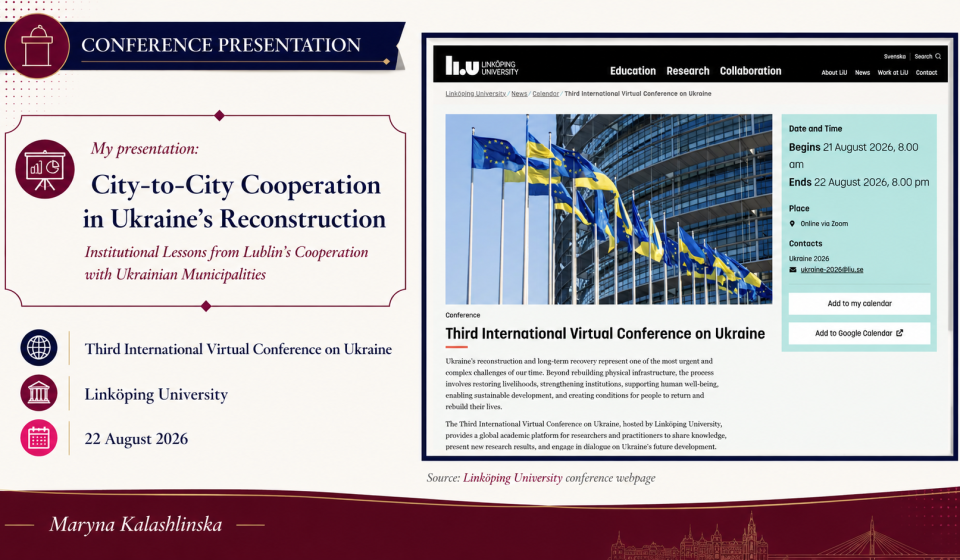
Presentation at the Third International Virtual Conference on Ukraine, Sweden
On 22 August 2026, I presented my paper “The Role of City-to-City Cooperation in Ukraine’s Reconstruction: Institutional Lessons from Lublin’s Cooperation with Ukrainian Municipalities” at the Third International Virtual Conference on Ukraine, hosted online by Linköping University, Sweden.
The conference brought together researchers and practitioners working on Ukraine’s reconstruction, long-term recovery, institutional development and socio-economic transformation.
My presentation focused on Lublin’s cooperation with Ukrainian municipalities after Russia’s full-scale invasion of Ukraine and on the broader question of how emergency municipal solidarity can develop into institutional capacity for reconstruction.
The case of Lublin demonstrates that city-to-city cooperation cannot substitute for state-led reconstruction, international donors or large-scale recovery programmes. It can, however, play an important intermediary role. Municipal partnerships can connect concrete local needs in Ukraine with trusted partners, administrative experience, project capacity, professional networks and wider European support.
I discussed how this cooperation developed from the emergency response of 2022. Lublin became an important humanitarian and organisational hub, while its existing network of partner and friendly cities provided channels through which assistance could be mobilised quickly. The work of the Lublin Social Committee for Aid to Ukraine also demonstrated the importance of coordination between local government, civil society, volunteers and other institutions during the first months of the full-scale war.
The presentation then moved from emergency assistance to the question of institutional continuity. Wartime cooperation creates relationships, routines, knowledge and trust that may remain valuable after the immediate crisis has passed. The central challenge is therefore not simply to preserve solidarity, but to translate it into more stable forms of cooperation capable of supporting recovery and reconstruction.
One example discussed in the presentation was cooperation connected with mobile shelters in Sumy, a city located close to the Russian border and exposed to continuing attacks. This case illustrates why the boundary between emergency assistance and reconstruction is not always clear. Protecting human life and maintaining everyday urban functioning under attack are themselves necessary conditions for any longer-term reconstruction process.
The presentation therefore approached reconstruction as more than the rebuilding of physical infrastructure. It also requires institutional relationships, local administrative capacity, knowledge exchange and mechanisms that allow municipalities to identify needs and connect them with partners able to respond.
From this perspective, city diplomacy and municipal cooperation can contribute to reconstruction through relatively small but concrete projects. Their importance lies not primarily in their financial scale, but in their ability to connect local knowledge with external resources and to build cooperation around clearly defined needs.
The main argument of the presentation was that solidarity opens the door, but institutions keep it open. Emergency cooperation can create the foundations for longer-term partnerships, but this transition requires continuity, organisational capacity and mechanisms that survive beyond the initial mobilisation produced by crisis.
Cities cannot rebuild Ukraine alone. Reconstruction will require national governments, European institutions, international organisations, donors and substantial financial resources. Yet reconstruction will also happen locally: city by city, project by project, and partnership by partnership.
I am grateful to the organisers of the Third International Virtual Conference on Ukraine for the opportunity to present this research and to exchange ideas with scholars and practitioners examining Ukraine’s recovery from different disciplinary perspectives.
Conference: Third International Virtual Conference on Ukraine
Conference dates: 21-22 August 2026
Presentation date: 22 August 2026
Host: Linköping University
Format: Online via Zoom
Contribution: “The Role of City-to-City Cooperation in Ukraine’s Reconstruction: Institutional Lessons from Lublin’s Cooperation with Ukrainian Municipalities”