Ensuring Confidentiality in Mediation of Political Conflicts
Political mediation depends not only on the mediator’s professional competence or the parties’ willingness to negotiate. It also requires an environment in which participants can disclose sensitive information, reconsider their positions and explore possible compromises without fearing that their statements will later be used against them.
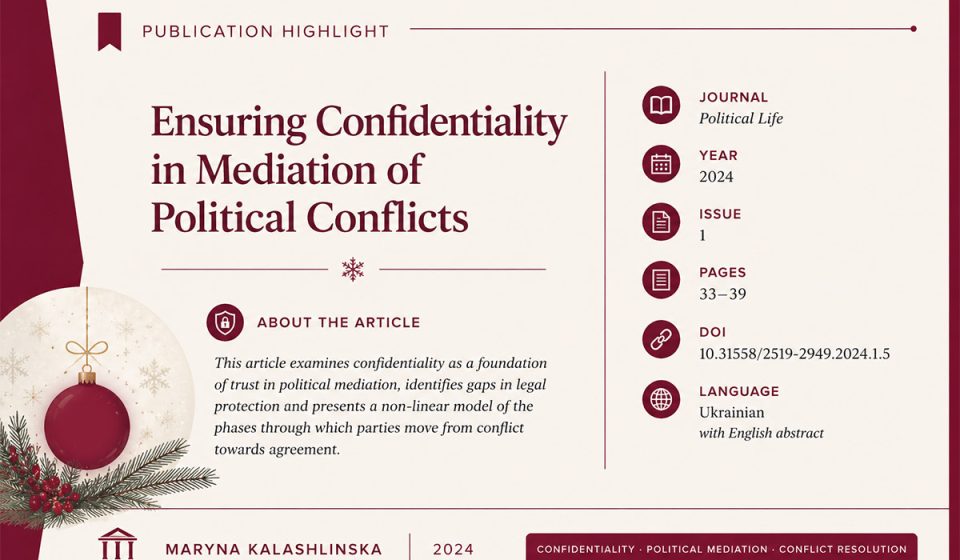
My article, “Ensuring Confidentiality in Mediation of Political Conflicts,” examines confidentiality as a central condition for trust in political mediation. It asks whether existing ethical and legal standards provide sufficient protection for sensitive information disclosed during mediation and considers how confidentiality should be maintained throughout the different phases of the mediation process.
The article was published in Ukrainian in Political Life in 2024. This English-language research note presents its central argument, legal analysis and principal findings for an international audience interested in political mediation, conflict resolution, negotiation, confidentiality and alternative dispute resolution.
Why Confidentiality Matters in Political Mediation
Professional mediation has become an established method of resolving civil, commercial, financial, family and other disputes. Its institutionalisation in these areas has normally required the recognition of the mediator’s professional role, the development of procedural rules and the creation of safeguards protecting the information disclosed by the parties.
Political conflicts present an even more demanding environment. They may concern strategic interests, access to power, national security, international relations or decisions affecting entire societies. Political actors may be particularly reluctant to disclose their true priorities, potential concessions or internal disagreements when such information can be exploited by opponents, the media or external actors.
Confidentiality is therefore not a secondary procedural feature. It is one of the conditions that allows the parties to communicate openly and enables the mediator to identify the real interests, values and motivations underlying their public positions.
The article argues that trust in political mediation cannot emerge automatically. It must be constructed through professional competence, a clear mediation structure, mediator neutrality and credible guarantees that confidential information will not be disclosed or misused.
From Direct Negotiation to Professional Political Mediation
Political conflicts are still frequently approached through direct negotiations. Direct dialogue may be effective when the parties are able to communicate constructively and possess sufficient motivation to reach an agreement. However, deeply polarised conflicts often involve destructive communication, strong emotions and mutually incompatible interpretations of events.
In these circumstances, a neutral third party can help reduce emotional tension, identify common interests and support the search for a realistic settlement. The mediator does not decide the dispute for the participants. Any final agreement must remain voluntary and must be developed and accepted by the parties themselves.
The article emphasises that mediation is not a universal solution to every political conflict. Nevertheless, its potential remains insufficiently developed in the political sphere. There are few specialised professional institutions and mediation centres designed specifically to address conflicts among political actors.
The professionalisation of political mediation is therefore presented as a strategically important step, particularly because decisions made in political conflicts may affect millions of people and, in some cases, the future stability of entire states or regions.
Confidentiality as an Ethical Principle and a Legal Obligation
One of the central problems identified in the article is the difference between recognising confidentiality as an ethical principle and guaranteeing it as an enforceable legal obligation.
The European Code of Conduct for Mediation Providers requires mediation-related information to be treated as confidential and calls on mediators to take reasonable measures to protect the level of confidentiality established by law, professional rules or agreement between the parties.
However, the code principally operates as a professional and ethical standard rather than a binding legal instrument supported by clearly defined sanctions. This creates uncertainty about the practical consequences of a breach and about the circumstances in which a mediator may be released from the obligation of confidentiality.
National legal systems may provide stronger protection in particular areas, such as civil or criminal proceedings. Yet these guarantees are usually connected to formally regulated categories of disputes and do not necessarily extend to political mediation.
The result is a significant gap between the recognised importance of confidentiality and the legal mechanisms available to enforce it in political conflicts.
Confidentiality under the Ukrainian Law on Mediation
The article pays particular attention to Article 6 of the Ukrainian Law on Mediation.
Under this provision, mediators, participants in mediation and organisations facilitating the procedure are generally prohibited from disclosing confidential information unless disclosure is required by law or all parties agree otherwise in writing.
Confidential information includes material obtained during both the preparation and conduct of mediation. This may encompass:
- the proposal to use mediation;
- the parties’ willingness to participate;
- facts and circumstances discussed during the process;
- statements and assessments made by participants;
- proposals for resolving the conflict;
- the content of the final mediation agreement.
A mediator may disclose information received from one party to another party only with the consent of the person who provided it. The law also restricts the examination of the mediator as a witness concerning information learned during the preparation or conduct of mediation.
These provisions formally recognise confidentiality as an essential mediation principle. The article nevertheless identifies an important weakness: the legislation does not clearly specify the mechanism or form of liability that would apply when confidential information is unlawfully disclosed.
Legal Gaps and Potential Risks
The Ukrainian Law on Mediation states that persons who disclose confidential information may bear liability established by law. However, the relevant form of liability and the precise legal provisions through which it would be imposed remain unclear.
The article also discusses the exception allowing a mediator to disclose information when this is necessary to defend against a claim concerning the performance of the mediation agreement. Although such an exception may be necessary to protect the mediator’s legal rights, it could potentially be misused by a party seeking access to sensitive information.
Courts and public authorities are expected to prevent unauthorised access to information disclosed in such proceedings. Yet the lack of clearly defined consequences for violating these safeguards may weaken confidence in the system.
Professional mediation organisations may introduce their own disciplinary measures, including exclusion from a professional association. Reputational consequences can also encourage compliance. However, professional discipline and reputational protection alone are insufficient when political actors are considering whether to disclose strategically sensitive information.
The article therefore calls for clearer and more effective legal mechanisms capable of guaranteeing confidentiality in political mediation and establishing meaningful responsibility for its violation.
The Non-Linear Phases of Mediation
A distinctive element of the article is its model of the phases through which understanding is reached in mediation.
The proposed model includes five principal phases:
- selecting the subject for discussion;
- working with emotions;
- searching for possible solutions;
- verifying whether the proposed agreement is realistic;
- signing the agreement.
Although these phases appear to form a linear sequence, the article argues that mediation is fundamentally dynamic and non-linear. Parties may return to an earlier phase when they discover that their disagreement is deeper than initially assumed or that a proposed settlement does not address the real source of the conflict.
For example, participants who have already begun evaluating a possible agreement may need to return to the initial definition of the problem. Similarly, renewed emotional tension may require further work before substantive negotiation can continue.
The mediator may adapt the order of the phases, omit particular steps or apply different tools depending on the circumstances. The effectiveness of the process therefore depends on the mediator’s professional judgement, the participants’ openness and the level of trust developed between them.
Confidentiality must be protected throughout all these phases. The parties may reveal different forms of sensitive information while discussing emotions, interests, possible concessions and the realistic limits of an agreement. A breach at any stage can undermine the entire process.
Central Argument and Research Contribution
The central argument of the article is that confidentiality is not merely one procedural principle among many. It is a structural condition for the existence of effective political mediation.
Without credible confidentiality safeguards, political actors may participate only formally, conceal their actual priorities or refuse to explore compromise. This limits the mediator’s ability to understand the conflict and reduces the likelihood of reaching a durable and realistic agreement.
The article connects three dimensions that are often considered separately:
- the institutional development of professional political mediation;
- the legal and ethical regulation of confidentiality;
- the internal dynamics and phases of the mediation process.
This combined approach demonstrates that confidentiality must be secured not only through general declarations or professional ethics but through legal rules, institutional procedures and the mediator’s conduct during every phase of mediation.
Research Methodology
The article adopts an interdisciplinary methodology based on structural functionalism and draws on concepts and research instruments from political science, law, psychology and sociology.
This approach reflects the multidimensional nature of political mediation. Political conflicts involve power and institutional interests, while the mediation process also depends on legal guarantees, communication dynamics, emotional reactions, group identities and interpersonal trust.
The research combines an examination of mediation institutions and professional standards with legal analysis of confidentiality provisions and a conceptual model of the mediation process.
Why This Research Matters
Confidential information is an important political resource. Consequently, uncertainty about how such information will be protected can become one of the main barriers to using mediation in political conflicts.
This research is relevant to scholars and practitioners working in:
- political mediation;
- international and domestic conflict resolution;
- negotiation studies;
- alternative dispute resolution;
- peacebuilding;
- mediation law and professional ethics;
- political communication and trust.
The article concludes that integrating professional mediation into political practice is strategically important but requires more than the appointment of a neutral intermediary. It requires institutions, procedures and enforceable confidentiality guarantees capable of convincing the parties that participation will not expose them to additional political or legal risks.
Further research should examine concrete cases of mediation in political conflicts and develop effective legal and institutional mechanisms for protecting confidential information in practice.
This article forms part of my broader research on political mediation and conflict resolution. My related study, “The Role of Mediation in Political Negotiations: Rethinking Traditional Approaches,” compares mediated dialogue with direct political negotiations and examines the practical functions of a third-party mediator.
The ethical responsibilities arising in such processes are examined in “Ethical Dilemmas of Contemporary Political Mediation: Adapting to Modern Challenges.”
Publication Details
Author: Maryna Kalashlinska
Original title: Забезпечення конфіденційності в медіації політичних конфліктів
English title: Ensuring Confidentiality in Mediation of Political Conflicts
Journal: Political Life (Політичне життя)
Year: 2024
Issue: 1
Pages: 33–39
Online publication date: 18 February 2024
Language: Ukrainian, with an English abstract
DOI: 10.31558/2519-2949.2024.1.5
Read the Article
Read the full article in the official journal PDF
View the article on the journal website
Recommended citation:
Kalashlinska, M. V. (2024). Ensuring confidentiality in mediation of political conflicts. Political Life, 1, 33–39. https://doi.org/10.31558/2519-2949.2024.1.5