New Article: The Transformation of Territoriality in the Sino-Mongolian Borderlands
Borderlands are often understood as geographical margins separated by state boundaries. Yet they are also political spaces in which governments regulate identity, language, historical memory, loyalty and the acceptable forms of cross-border connection.
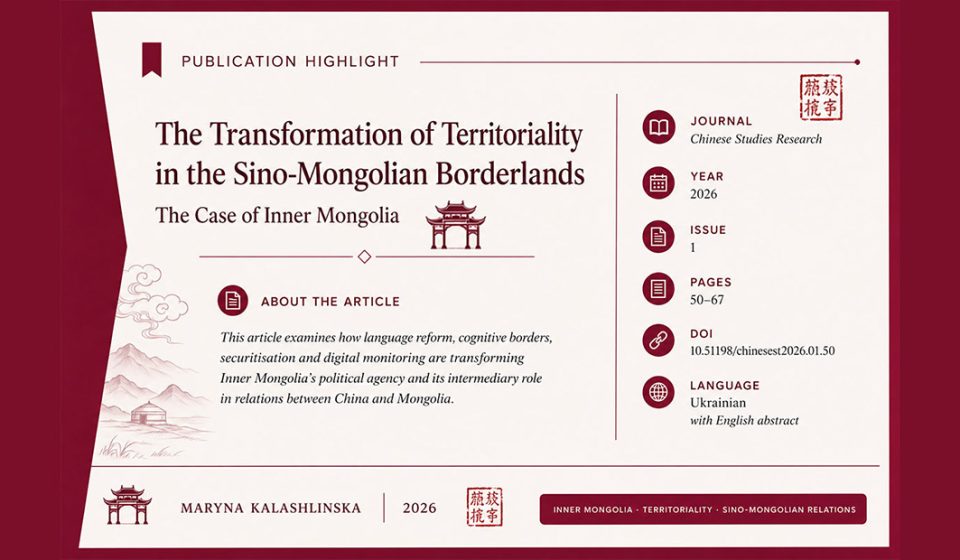
My article, “The Transformation of Territoriality in the Sino-Mongolian Borderlands: The Case of Inner Mongolia,” examines how the changing ethnopolitical and legal course of the People’s Republic of China between 2020 and 2026 has reshaped Inner Mongolia as a formally autonomous border region.
The study asks how China’s increasing centralisation, language and education reforms, new legislation and securitisation of regional identity affect both the political agency of Inner Mongolia and its role in relations between China and independent Mongolia.
The article was published in Ukrainian with an English title, abstract and keywords in Chinese Studies Research in 2026. This English-language research note presents its theoretical framework, methodology, central argument and principal findings for an international audience interested in territoriality, border studies, Chinese ethnic policy, Inner Mongolia and Sino-Mongolian relations.
Borderlands as Political and Symbolic Spaces
The article approaches borders not as fixed lines on a map but as continually produced political and social arrangements.
Contemporary states exercise territorial control through more than physical administration, security institutions and border infrastructure. They also shape the institutional conditions under which local communities reproduce their language, culture, historical narratives and collective identity.
This perspective is particularly important in autonomous border regions. Such territories may formally retain their administrative status while gradually losing their capacity for political self-representation.
Inner Mongolia is a significant case because it combines several characteristics:
- formal status as an autonomous region of the People’s Republic of China;
- a distinct Mongolian linguistic and cultural heritage;
- historical and symbolic connections with independent Mongolia;
- strategic importance in China’s northern border policy;
- a former role as a cultural and political intermediary between Beijing and Ulaanbaatar.
The article therefore treats Inner Mongolia not merely as an administrative unit but as a borderland whose internal political transformation has consequences extending beyond China’s domestic affairs.
From Flexible Autonomy to Rigid Integration
The central argument is that Inner Mongolia is undergoing a transition from a relatively flexible model of regional autonomy to a model of increasingly rigid integration.
Flexible autonomy did not mean complete political independence from Beijing. It referred to an arrangement in which regional linguistic, cultural and institutional specificity was formally recognised and partially preserved.
This model allowed the central government to exchange limited cultural and regional autonomy for political loyalty and border stability. It also enabled Inner Mongolia to function as a cultural bridge between China and Mongolia.
Under the emerging model of rigid integration, autonomy is not formally abolished. Instead, its practical political meaning is narrowed.
Autonomous institutions increasingly transmit and implement national policies rather than independently representing regional interests. Local specificity remains visible, but primarily in forms compatible with state-defined political loyalty, national unity and cultural standardisation.
The transformation is therefore more complex than conventional administrative centralisation. It concerns the state’s capacity to determine which forms of regional identity may be expressed publicly and which are interpreted as politically sensitive.
Language and Education as Instruments of Territorial Governance
The language and education reforms introduced in Inner Mongolia from 2020 marked a particularly important stage in this transformation.
Changes presented as reforms of bilingual education expanded the role of putonghua, or standard Mandarin Chinese, in subjects previously taught in Mongolian. Language, literature, politics and history became central areas of institutional change.
These reforms affected more than classroom communication. The language of education influences how historical knowledge is transmitted, how political concepts are interpreted and how younger generations relate to their cultural community.
The large-scale protests that followed the 2020 reforms demonstrated that Mongolian-language education was perceived as a foundation of regional cultural and political agency.
Parents withheld children from school, students participated in strikes and petitions circulated across the region. The protests involved not only dissident groups but also teachers, public officials and members of the Communist Party of Chinese origin.
The response of the authorities revealed the limits of acceptable autonomy. Regional specificity remained recognised only to the extent that it did not generate an alternative space of loyalty, memory or collective mobilisation.
The article interprets the 2020 language crisis as a turning point at which the tension between formal autonomy and substantive political agency became especially visible.
The Legal Consolidation of Integration
The study also examines Chinese legislative developments in 2025 and 2026 as indicators of a broader transformation in the governance of autonomous territories.
The revision of the Chinese law on the standard spoken and written language strengthened the legal foundations for prioritising putonghua in education and public institutions.
The 2026 Law on Promoting Ethnic Unity and Progress further connected ethnic policy with national unity, political stability and state security.
These changes do not immediately remove the constitutional or administrative status of autonomous regions. Their significance lies in the gradual reinterpretation of autonomy.
Regional difference is increasingly incorporated into the official concept of a unified Chinese nation. Cultural particularity may continue to exist, but it is expected to operate within centrally defined political, linguistic and symbolic boundaries.
The article therefore distinguishes between the formal preservation of autonomy and the narrowing of its actual political content.
Five Dimensions of the Transformation of Territoriality
The study identifies five interconnected dimensions through which territoriality in Inner Mongolia is being transformed.
1. From mediated to direct territoriality
The earlier model of governance relied partly on regional elites, local institutions and limited cultural autonomy. These mechanisms mediated relations between the central government and the local population.
Rigid integration replaces this multi-level arrangement with more direct forms of political, linguistic and administrative control.
As regional elites and autonomous institutions lose their intermediary role, territorial governance becomes an increasingly direct projection of central authority.
2. Reterritorialisation of the borderland
Reterritorialisation involves replacing earlier meanings attached to a territory with new political codes.
Inner Mongolia was historically situated within a wider Mongolian cultural space extending across the international border. Its language, historical memory and traditional script connected the region symbolically with independent Mongolia.
The emerging political model seeks to weaken these transborder meanings and reposition Inner Mongolia primarily within the narrative of a unified Chinese nation.
The region is therefore being transformed from a contact zone between related communities into a more tightly controlled space of national integration.
3. Control of language, education, memory and communication
Territorial control increasingly operates through everyday institutions and practices.
The border is reproduced not only at the physical boundary between China and Mongolia but also in schools, textbooks, language regulations, museums, public ceremonies and communication networks.
Through these instruments, the state can influence how residents understand the past, interpret their regional identity and imagine their place within a wider Mongolian cultural world.
4. Securitisation and digital visibility
The article also examines the growing tendency to interpret autonomous identity and transborder cultural connections through the language of security.
Practices that might previously have been treated as expressions of regional cultural life may increasingly be viewed as potential risks to unity or stability.
Administrative surveillance, pressure on protesters and control of communication make local communities more visible to state institutions. Digital monitoring can restrict autonomous communication and collective mobilisation without physically closing the border.
The article treats these developments carefully. It does not simply transfer evidence from Xinjiang or Tibet to Inner Mongolia. Instead, it identifies a wider Chinese tendency towards technologically supported administrative oversight while focusing on documented pressure and surveillance connected with the 2020 language protests.
5. Construction of cognitive borders
The concept of cognitive borders constitutes one of the article’s principal theoretical contributions.
Cognitive borders are not physical barriers. They define the limits of publicly acceptable interpretations of history, language, identity and political loyalty.
A physical border separates one state from another. A cognitive border separates the state-authorised understanding of a territory from alternative ways of remembering its past or imagining its cultural and political connections.
In Inner Mongolia, cognitive bordering can occur through education, linguistic policy, public symbolism and commemorative practices. These instruments encourage residents to interpret Mongolian history and identity primarily through the framework of Chinese national unity.
Historical Memory and the Reinterpretation of Mongolian Identity
The article shows how commemorative politics contributes to the transformation of territoriality.
Historical figures, monuments, museums, public holidays and traditional celebrations do not simply preserve the past. They also communicate particular understandings of political belonging.
The figure of Genghis Khan provides an important example. For many Mongolians, he represents sovereignty, historical continuity and national pride. In Chinese official discourse, however, his legacy can be incorporated into the history of the Yuan dynasty and the broader narrative of China as a unified multinational civilisation.
Mongolian heritage is therefore not necessarily erased. It is reinterpreted and incorporated into a state-centred historical framework.
Similar processes affect traditional festivals such as Naadam. Cultural celebrations may be preserved as folklore or tourism while being separated from political meanings associated with collective autonomy or transborder Mongolian unity.
This produces a controlled form of cultural visibility: regional difference remains present but loses part of its capacity to support alternative political or historical narratives.
The Declining Transborder Role of Inner Mongolia
Inner Mongolia once provided Beijing with an important channel of cultural and educational influence in Mongolia. Its Mongolian-language institutions, traditional vertical script and cross-border networks helped present China as a state capable of accommodating Mongolian identity.
This gave the region a role in Chinese soft power and contributed to a degree of predictability in Sino-Mongolian relations.
As the autonomous specificity of Inner Mongolia is reduced, this intermediary role becomes more difficult to maintain.
The region increasingly functions not as a bridge between two societies but as a controlled borderland through which communication, identity and cultural circulation are filtered.
This change has direct foreign-policy consequences. Developments inside Inner Mongolia are closely observed in Mongolia, where the weakening of the Mongolian language and cultural autonomy is viewed with concern.
Mongolia’s Dilemma: Cultural Solidarity and Economic Dependence
Public opinion in Mongolia has shown considerable sensitivity to developments in Inner Mongolia. The 2020 language reforms generated civic mobilisation, media attention and expressions of cultural solidarity.
The official response of the Mongolian government, however, remained cautious.
This restraint reflects the structural asymmetry of Sino-Mongolian relations. Mongolia depends heavily on China for access to markets, commodity exports, transport routes, border trade and major infrastructure projects.
Open criticism of China’s internal policy could therefore produce serious diplomatic and economic costs.
Ulaanbaatar consequently combines cultural concern with a strategy of quiet diplomacy. The erosion of Inner Mongolia’s autonomous specificity represents a foreign-policy challenge, but Mongolia possesses limited instruments through which to respond directly.
China’s internal border policy thus acquires an external political dimension. It affects trust, cultural relations and the symbolic foundations of cooperation between the two neighbouring states.
Research Methodology
The study combines three principal methodological approaches:
- a case study of Inner Mongolia;
- critical discourse analysis;
- the analytical tools of critical geopolitics.
The case-study approach makes it possible to examine Inner Mongolia as a distinct political and historical context rather than treating all Chinese autonomous regions as identical.
Critical discourse analysis is applied to legislation, official political narratives and public formulations concerning language, ethnic unity, autonomy and the unified Chinese nation.
Critical geopolitics makes it possible to analyse the borderland as a politically produced space in which territorial administration intersects with symbolic representations, security practices and transborder relations.
Together, these methods reveal three interconnected levels of change:
- the legal and institutional regulation of autonomy;
- the discursive redefinition of regional identity;
- the changing transborder role of Inner Mongolia in relations between China and Mongolia.
The article specifically avoids mechanically transferring the experiences of Xinjiang or Tibet to Inner Mongolia. Comparisons with other autonomous regions are used as contextual references, while the analysis remains centred on the particular institutional, linguistic and transborder characteristics of the Inner Mongolian case.
Research Contribution
The article makes two main conceptual contributions.
First, it develops the concept of cognitive borders as a component of contemporary territoriality. Territorial power is understood not only as control over land and institutions but also as the authority to define legitimate memory, language, identity and political belonging.
Second, it connects the internal transformation of regional political agency with international relations. The narrowing of autonomy inside China changes how Inner Mongolia can function in relation to a neighbouring state with which it shares historical and cultural ties.
This approach demonstrates that domestic ethnic and language policy can reshape the configuration of bilateral relations even without changing the formal international border.
Why This Research Matters
The case of Inner Mongolia contributes to wider debates about:
- contemporary territoriality and bordering;
- centre-periphery relations;
- political agency in autonomous regions;
- language policy and cultural reproduction;
- the securitisation of identity;
- digital governance and state surveillance;
- critical geopolitics;
- China’s relations with neighbouring states.
The article also shows why the formal existence of regional autonomy is not sufficient for evaluating its political significance.
A territory may retain its official institutions while losing the practical capacity to represent its linguistic, cultural and historical specificity. Understanding this distinction is essential for analysing contemporary state-building strategies and the changing political role of borderlands.
The study forms part of my broader research on territoriality, political agency, border regions and non-physical forms of political control.
Publication Details
Author: Maryna Kalashlinska
English title: The Transformation of Territoriality in the Sino-Mongolian Borderlands: The Case of Inner Mongolia
Ukrainian title: Трансформація територіальності у китайсько-монгольському прикордонні: кейс Внутрішньої Монголії
Journal: Chinese Studies Research
Year: 2026
Issue: 1
Pages: 50–67
Publication date: 5 June 2026
Language: Ukrainian, with an English title, abstract and keywords
DOI: 10.51198/chinesest2026.01.50
Access: Open Access
Licence: Creative Commons Attribution-NonCommercial 4.0 International
Read the Article
Published in Chinese Studies Research, 2026.
DOI: https://doi.org/10.51198/chinesest2026.01.50