
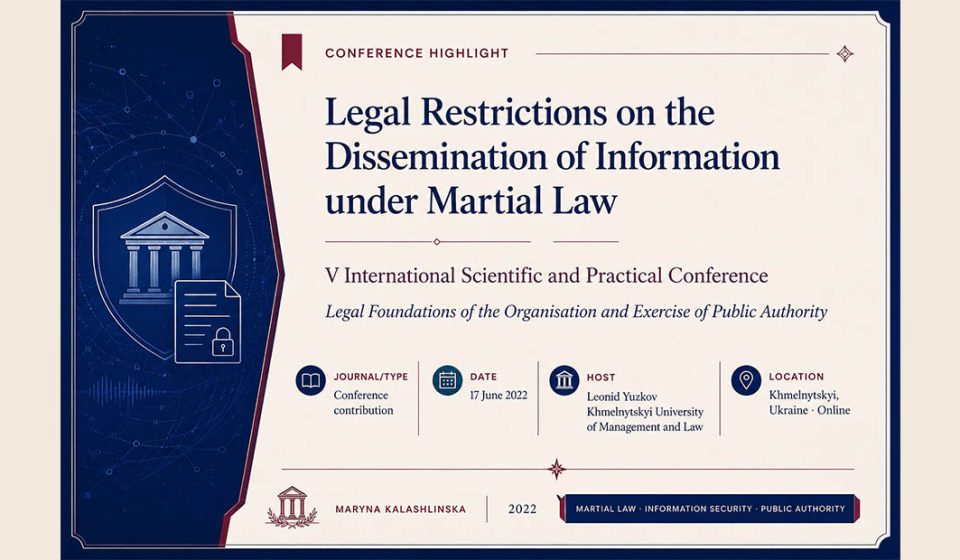
International Scientific Conference on Public Authority under Martial Law: Legal Restrictions on Information Dissemination
On 17 June 2022, I participated in the V International Scientific and Practical Conference “Legal Foundations of the Organisation and Exercise of Public Authority”, held by the Leonid Yuzkov Khmelnytskyi University of Management and Law. My contribution was devoted to “Legal Restrictions on the Dissemination of Information under Martial Law.”
The paper addressed one of the most urgent legal and institutional challenges that emerged after the beginning of Russia’s full-scale invasion of Ukraine: how public authorities can protect sensitive information without depriving society of access to timely and reliable communication.
Under ordinary conditions, access to information is an essential element of democratic governance. It enables public oversight, supports accountability and allows citizens to understand the decisions of state and local authorities. Martial law, however, changes the security context in which this right is exercised. Information concerning military units, weapons, transport routes, strategic infrastructure or the consequences of attacks may be used by the aggressor and create direct risks for national defence and human life.
The contribution examined the constitutional basis for temporary restrictions on certain rights and freedoms during martial law, including the right to collect, store, use and disseminate information. It also considered the legal changes introduced in Ukraine during the first months of the full-scale war, particularly criminal liability for the unauthorised disclosure of information concerning the movement of weapons and the location or activities of the Armed Forces of Ukraine and other military formations.
The central argument was that wartime restrictions should not be understood simply as a prohibition on communication. Their purpose is to protect information whose disclosure may create a specific security threat. At the same time, restrictions must remain legally grounded, proportionate and connected with the conditions of martial law. Otherwise, the protection of national security may develop into excessive secrecy, inconsistent institutional practices or an unjustified limitation of public oversight.
A separate part of the analysis concerned the transformation of public administration during wartime, including the creation of military administrations. These temporary state bodies were introduced to support defence, civil protection, public order and the implementation of measures required under martial law. Their establishment changed the distribution of authority and created new procedures for making and communicating public decisions.
The paper drew attention to a practical contradiction. During a war, official information must be verified before publication because inaccurate or premature disclosure may produce serious consequences. Verification and interinstitutional coordination, however, take time. If public authorities communicate too slowly, an information vacuum may emerge and be filled by rumours, unofficial reports, manipulation or enemy disinformation.
The effectiveness of wartime governance therefore depends not only on the ability to classify or restrict sensitive information. It also depends on the capacity of public institutions to communicate quickly, clearly and consistently about matters that can safely be disclosed. Citizens need reliable instructions, explanations of legal changes and accurate information about public services, evacuation, security measures and the work of state institutions.
This makes information policy a central component of public resilience. The legal regulation of wartime communication must combine security, institutional responsibility and public trust. Restrictions alone cannot produce an effective information environment. They must be accompanied by clear rules, coordinated official communication and an understanding that timely information is itself an important public service.
The contribution concluded that the information dimension of wartime governance is inseparable from the wider organisation of public authority. The resilience of the state depends not only on military and economic resources, but also on its ability to protect sensitive data, counter hostile information activities and maintain credible communication with society.
The conference was dedicated to the memory of Leonid Yuzkov, a founding academician of the National Academy of Legal Sciences of Ukraine and the first Chairman of the Constitutional Court of Ukraine. Its programme brought together scholars and practitioners working on constitutional, administrative and financial aspects of public authority, territorial organisation, electronic governance and the functioning of state institutions under martial law. The event was organised by the Leonid Yuzkov Khmelnytskyi University of Management and Law in cooperation with academic institutions specialising in state building, local self-government and public administration.
Conference: V International Scientific and Practical Conference “Legal Foundations of the Organisation and Exercise of Public Authority”
Date: 17 June 2022
Location: Khmelnytskyi, Ukraine, online format
Contribution: “Legal Restrictions on the Dissemination of Information under Martial Law”